Ron Toland
About Canada Writing Updates Recently Read Photos Also on Micro.blog
  • Keeping Score: January 4, 2019

    Absolutely 0 words written this week.

    But! I’ve not been idle. I submitted two short stories (to different markets), and I’ve been making progress on editing my most recent novel.

    The week of Christmas I was able to do a first read-through, making notes as I went. I ignored things like word choice or sentence structure, and looked for higher-level problems: scenes where the characters' actions were inconsistent, or the physics of the place didn’t match up, or where the timeline didn’t make sense.

    I found a lot of problems that I’ll have to fix. But I was happy to find that I still like the characters, and their story, and want to make it the best version I can.

    So this week I cracked open my copy of Writing the Breakout Novel: Workbook, by Donald Maas. Jonathan Maberry recommended it at one of the last Writers' Coffeehouses; he told us that he buys a new one for each novel he writes, and works through it as part of his editing process. So I’m giving it a shot.

    The book is basically a writing workshop in written form. Each chapter describes a writing technique, a way to improve your manuscript, and ends with exercises to push you to use that technique in your own novel.

    I’ve gotten through 6 chapters so far, and while I balked at first (“don’t you tell me my protagonist isn’t heroic enough,” my internal rebel snarled), when I forced myself to work through them, the exercises generated a lot of new ideas for the book. Nothing too radical, as yet, but definite ways to make what I’ve got better, to make my characters' personalities clearer and my scenes more interesting.

    So I plan to keep going, working through one chapter a day. That’ll put me on track to have it completed by the end of the month, at which point I can start collating all these ideas and plan out the editing passes I’m going to make on the book.

    The goal is to have all the editing passes finished and it ready to submit to agents by the end of the year.

    Wish me luck.

    → 3:55 PM, Jan 4
  • 2018: By the Numbers

    Oof, 2018.

    So many times this year, my wife and I looked at each other, reminiscing about something that happened to us, and said “was that really last week?”

    I don’t know how a year can both feel like it’s whizzing by at 88 miles per hour, and be cramming in a month’s worth of events in every single week, but this one did.

    So, to help me remember the sheer number of things that have happened this year, I’m going to set them all down. Well, as many as I can recall, anyway.

    Writing

    Since I started my new scoring system in February (which, again, thanks to Scott Sigler for sharing that with us at a Writers Coffeehouse), I’ve written 71,902 words.

    Most of those were on the novel that I finished (finally!) in November. I did write one new short story, though, and edited four others.

    I submitted just one story to three new markets, all of which rejected it.

    Reading

    Thanks to Goodreads' singularly bad UI, I have no idea how many books I read in 2018. It’s something north of 20, but that’s all I know.

    Personal

    I moved not once, but twice, in 2018. First move was from rental to rental, second was to the house we bought in July.

    Neither one was easy, though the second put a bigger dent in our finances, not least because we had to completely redo the upstairs flooring and master bath in order to move in.

    Here’s hoping there’s no more moves for me in the near future.

    Oh, I also started an exercise routine (walking 3/week, yoga 2/week) and taking French lessons through Babbel. But I’m holding off counting those “for real” until I either drop a pant size or can read an Asterix comic in the original (preferably both).

    Travel

    I also traveled…a lot. Maybe more than I should have.

    February was the JoCo Cruise, March was WonderCon, May was San Francisco (work), June was Downtown LA, July was the move (yeah, I’m counting it twice), October was Ireland (work), November was Boston and DC, December was Seattle (work again).

    Tbh, I’m looking forward to January through March, if only because I know I’ll be sleeping in my own bed that whole time.

    2019

    So what lessons can I draw from these figures?

    First, when writing a first draft, I need to be more aggressive with my weekly writing goal. It felt like I wrote a lot more than just 70K words this year, and that’s probably a function of how long I was working on the same piece. If I were to maintain the 2,500 words a week pace I had at the end of the year, I’d double my output next year.

    Second, I need to submit more. There’s really no reason to let a story that’s complete and edited sit on the shelf. I need to get back into the habit of sending a story out again as soon as it gets rejected. No more dithering.

    Third, I need to stop using Goodreads. There’s just no excuse for an interface that’s that bad. And I’m fortunate enough to know how to build my own replacement, so that’s what I should do.

    Finally, I might need to actually travel less. It sounds counter-intuitive, but it interrupts my writing work, and given I’m also working a full-time job that requires a lot of my brain’s meager capacity, I can’t afford to lose that time. Unless I can find a way to keep writing, even while traveling, I need to cut down.

    → 5:19 PM, Dec 28
  • Midlife, by Kieran Setiya

    Picked this one up during my last trip through Boston. I’m inching closer and closer to forty, so it seems like a good time to take stock of what I’ve accomplished so far in my life (not much, really) and where I might want to go from here.

    I’d hoped this book would help with that, or at least with countering any fears or anxieties I experience as I enter middle age.

    Unfortunately, it’s a mostly disappointing book.

    An Audience of One

    Part of that is due to a flaw he admits right up front: it’s a book he wrote for himself. Someone who’s entered middle age as one of the professional classes, with a stable job, a stable home life, and good health. And not just any job, but the job he set out to get in his twenties. So he comes at middle age from the perspective of someone who’s already achieved the things they wanted out of life.

    The book suffers for it. For how many of us set out to do one thing in our youth, only to end up somewhere entirely different? Or enter middle age with our bodies broken, or our minds? Do we have nothing to learn from philosophy?

    Abandoning Reason

    The second flaw follows directly from the first: he discusses arguments for dealing with certain aspects of middle age, such as the fear of death, but dismisses anything that doesn’t feel right for him. Abandoning reason, he moves from philosophy to pop psychology, deciding that what gives him the most comfort must be the best.

    Never mind that what might comfort him would be appalling to someone else. Or that comfort might have little to do with the truth.

    Paths Not Taken

    And so he glosses over the insights embedded in the not-self dogma of Buddhism. Skips right over the most reasonable argument for not fearing death. And misses a gaping hole in the middle of his whole argument.

    For embedded in the heart of his book is an assumption: that philosophy is meant to help us be happy.

    But what if that isn’t the case? If we take philosophy as being the study of how to live a good life, does it necessarily follow that the good life is a happy one?

    I don’t think so. At the very least, I don’t think it’s something we can assume. For while it is a modern trend to conflate happiness with virtue (or perhaps merely a particularly American one), there are plenty of examples from ancient philosophy where that isn’t the case. Consider Stoicism, where virtue can only be shown in the face of adversity.

    Final Words

    So while Midlife claims to be a mix of philosophy and self-help, it is neither. Not philosophy, because it leaves reason behind in the pursuit of comfortable aphorisms. And not self-help, because it was written to help only one person, the author.

    Frustrating at its worst, disappointing at its best, I wouldn’t recommend this book.

    → 4:00 PM, Dec 21
  • Seattle

    I’ve spent the last week up in Seattle for a conference. It’s not my first time in the Pacific Northwest (I’ve been to Portland once or thrice) but it is my first time in the Emerald City.

    Overall, I’ve had a good time, but there’s been some…bumps…along the way.

    First Impressions

    Things got off to a rocky start.

    A young woman demanded I gave up my seat on the commuter rail in from the airport, not by asking, but by standing in the aisle, glaring at me, and then saying “Well?!”

    Later, when I tried to get in an elevator that was about half full, the guy blocking the doorway just stared at me, and refused to let me by, even after I asked him if I could get in.

    And I’ll not mention the number of cars that tried to run me over as I was crossing the street (at a crosswalk, with the light green).

    This was all the first day. People I met later on (at the conference, when eating out, etc) were cool and friendly, but that first impression…lingers.

    Architecture

    I'm not sure what I was expecting Seattle buildings to look like, but I definitely wasn't expecting this thing, which looks like it's going to fall over any second now:

    Or this, which looks like someone framed out half a building and decided “eh, it’s good enough”:

    I mean, I like ‘em, they’ve got a cool sci-fi vibe to them. But damned if I can explain ‘em.

    Hills

    Ye gods, Seattle is hilly. San Francisco, eat your heart out.

    You can see why I never had any trouble meeting my Apple Watch’s Move demands each day.

    Weather

    I've discovered December is the wrong time to visit Seattle.

    Not when I throw open the curtains in my hotel room, hoping for some morning sun, to find this:

    I think I’ve seen the sun once all week. Suddenly I understand how grunge music came from this place.

    MoPop

    I can forgive everything, though, for the Museum of Pop Culture.

    Housed in another building that looks like it just dropped in from a sci-fi movie lot, this place is amazing. I spent three hours there on Wednesday night, and it still wasn’t enough.

    How could it be, when they’ve got original models used in filming Aliens:

    And Gimli’s helmet:

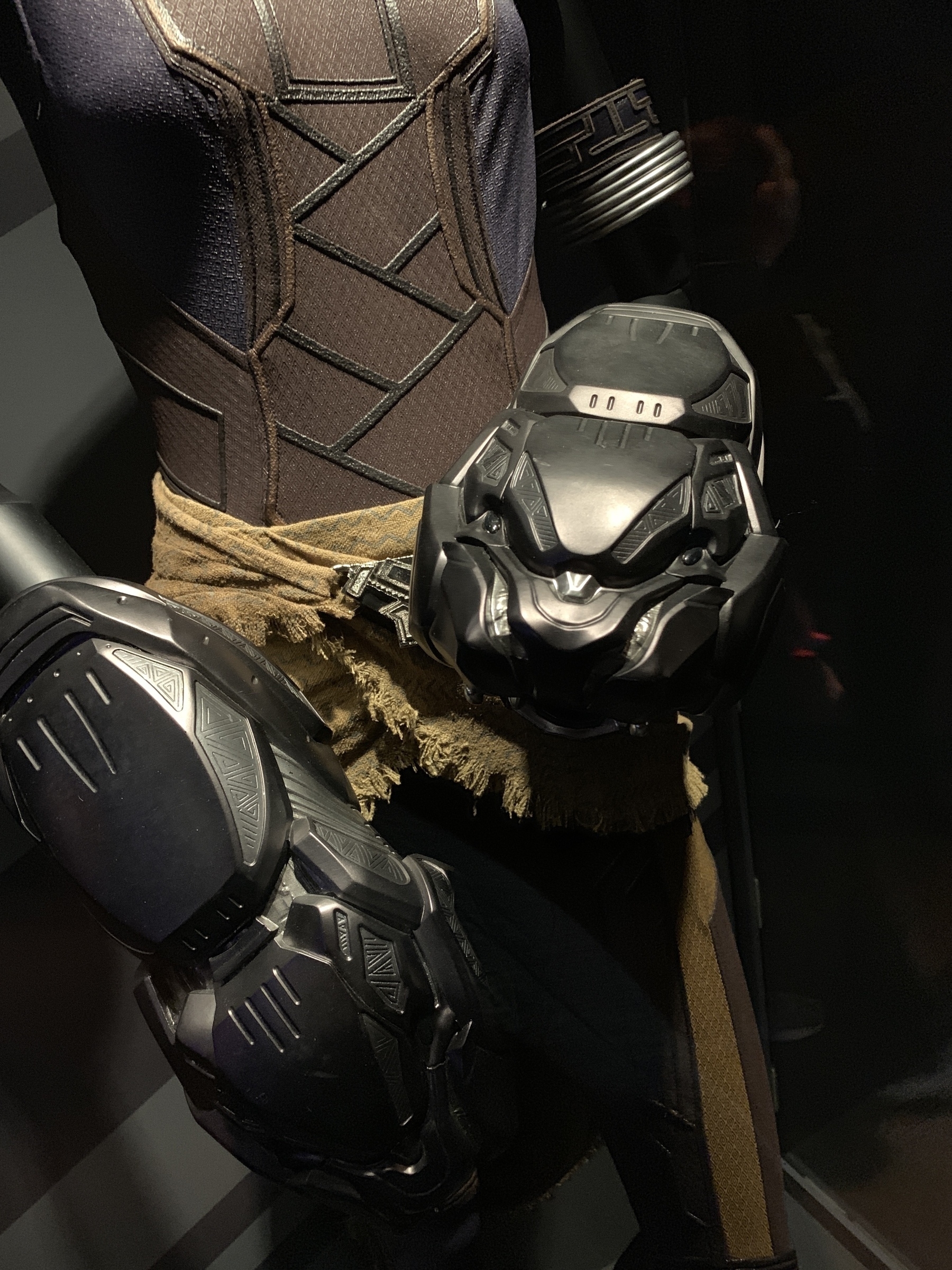
    And Shuri’s gloves:

    They even did up the hall where the Doctor Strange props and costumes are exhibited in mirrors and glass, so it looks like you’ve stepped into the mirror dimension:

    Wow.

    Conclusions

    I definitely want to come back. There's a technical bookstore I want to browse, a bunch of machines at the Living Computers museum I want to play with, and too many breweries I want to patronize.

    But I’ll wait for the late spring, maybe summer, when I can actually, you know, see things.

    → 4:34 PM, Dec 14
  • Rebooting My Writing Brain

    When I finished the first draft of the latest novel two weeks ago, I told myself I could take the rest of the year off. Maybe do some editing of a few short stories, but no real work till the first of the year, when I planned to dive into editing the novel.

    So, of course, I’m already outlining my next book.

    It surprised me. For a good week there it felt weird to not be writing, but also rather good. I had more time to exercise, to study French, to simply read again.

    But then I read Cicero, followed by Legion vs Phalanx, and that connected up with an idea for a YA novel I’ve had bouncing around in my head, and suddenly I’m writing down characters and plot points and trying to work this story into shape.

    It’s like a damned addiction, this writing thing.

    I’m not keeping score, though; not yet. I want time to think things over, to brainstorm and throw ideas away, before committing to daily, serious work.

    For now, it’s time to play.

    → 4:00 PM, Dec 7
  • Cicero, by Anthony Everitt

    Masterful. Not only did I get a better sense of who Cicero was as a person, and why he was important, I also got a good feel for the politics of the late Roman Republic. More specifically, Everitt lays out the flaws inherent in the Roman system that – coupled with the stubborn refusal to change of most Senators – led to its downfall and the birth of the Empire.

    I found this book easier going than Everitt’s biography of Augustus. They’re both good, don’t get me wrong, but I never felt lost in dates and events in Cicero, because Everitt constantly tied things back to the larger movements of the period. It gave me a better perspective, and also let me see how important Cicero really was.

    For example, after watching the HBO series Rome (which is fantastic, highly recommend checking it out), I thought of Cicero as little more than a pompous windbag, unable to make up his mind or stand for anything.

    On the contrary, while he could be long-winded, and tended to talk up his deeds too much, he was a capable administrator (he was only sent to govern provinces twice, but both times was very popular with the locals for being competent and incorruptible) and a rare thing in the late Republic: a Senator that sided with the wealthy (optimates) but wanted to change things just the same. Not to mention his original claim to fame as a great orator, which he won by ably defending clients in the courts.

    He even, apparently, had some skill as an investigator. While on his second tour as a provincial governor, he uncovered a banking scandal that was being run by Marcus Brutus (the Brutus that later was one of Caesar’s assassins!).

    In short: Highly recommended if you’re interested in Roman history, or even (like me) just curious to know more about the personalities glimpsed through series like Rome.

    → 4:02 PM, Dec 4
  • Writers Coffeehouse: December 2018

    Another great coffeehouse! Since it’s December, we had a bit of a holiday pot-luck: people brought EggNog (spiked and not-spiked), cookies, candy canes, and wine. They also collected Toys for Tots, and even lit the first two candles of a menorah in honor of the first night (upcoming) of Hanukkah.

    Lots of people had just wrapped up NaNoWriMo, so there was a lot of good news to go around. Biggest news was probably Henry Herz getting published in Highlights for Children, which is (apparently) a wickedly hard market to crack.

    My notes are below. Congrats to Henry and all the NaNoWriMo winners! And, as always, many thanks to Mysterious Galaxy for hosting us, and Jonathan Maberry for running the Coffeehouse!

    • the one golden rule: no writer bashing; like or dislike the twilight books or da vinci code, but they opened doors for thousands of other writers and injected billions into the books industry
    • san diego writer's festival: april 13th, central library, similar folks to the festival of books
    • option prices have dropped a lot since the recession; standard is now $5K, but can include lots of extras, like five-star treatment to get to set, executive producer credit (paycheck per episode), royalties per tv episode, etc
    • remember that your agent is a business partner; don't be afraid to contact them, but don't think they're your best friends, they work for you, and you can learn a lot from them; agents love writers that are business savvy
    • nov and dec used to be a bad time for agents, but since it's the slow season, it's a good time to submit to them; ditto pitches to editors of magazines for articles to write
    • "we're looking for original stories, not original submission practices"
    • when selling anthology to publisher, need a few big names on there so they feel that it'll definitely sell
    • maberry: budgets 10 min out of every hour for social media; has a lot of pages and has to manage them, and manage his time on them
    • henry herz: got article accepted into highlights magazine! very hard market to crack
    • january coffeehouse will be about pitching; will also do sample panel
    • on a panel: they're looking for a celebrity, need people to be a little larger-than-life; sometimes audience will ask questions they know the answers to, just to hear a celebrity say it
    • being a panelist is a skill; you need to be a slightly different version of yourself that the public will accept as "writer"
    • neil gaiman is naturally very awkward; had to hire an acting coach to script out appearances so people will get to see the "neil gaiman" they come to see
    • pitching, being on a panel, these are all skills you need to practice, but they *are* skills you can develop and improve, even if you're a complete introvert
    • exercise: pick your favorite novel (or movie), and pitch it as if you wrote it; something you know well enough to do without notes
    • need to be good at it and comfortable with friends so that when in front of agents you aren't so scared and vulnerable
    • people are more comfortable with peers than with people that put them on a pedestal
    • recommends using donald maas' workbook on writing the breakout novel; the way it's intended is after a first draft is done, makes you drill deeper into the book
    • also: don't revise until after you've waited a month and then also read the whole thing through again
    • finally: do revising in waves; handle one change at a time, to make them manageable
    • unsure whether to make book a mystery or fantasy? write the book you'd have the most fun writing; if unsure of audience, pick the one you'd have fun writing for and go all in
    → 4:11 PM, Dec 3
  • On The Origins of Totalitarianism

    Recently finished reading Hannah Arendt’s Origins of Totalitarianism.

    It’s hard for me to talk about, because the book is filled with such piercing, clear-eyed insight, that if I tried to summarize it properly, I’d end up reproducing it.

    I could say that I think the book should be required reading for any citizen of any country, in any age, because I do. And not because of any simplistic need to show that “Nazis are bad,” which (while true) doesn’t need an entire book to demonstrate. The testimony of even one concentration camp survivor should be enough for that.

    I think everyone should read The Origins of Totalitarianism because it shows how the logic of totalitarian governments grows out of capitalism itself. Not that capitalism must always lead to totalitarianism, but that it always can. Just as racism and nationalism don’t always lead to a Final Solution, but without racism and nationalism, without some ideology claiming to override our humanity, a Final Solution is not even conceivable.

    And yes, I think there are passages of the book, describing the methods of the Nazis and the communists (for Stalin’s government was also a totalitarian one) that are too close to our current administration for my comfort. I can’t read about the Nazis contempt for reality, or the way people in totalitarian movements will both believe the lies told by their leaders and praise them for their cleverness when the lies are revealed, without thinking of how right-wing nationalists in my own country treat the current President. But even if these things were not happening in the United States, it would be a book worth reading.

    It is, in short, rightly called a classic. A long one, and a hard one, if we take its insights to heart as readers (passages calling out the middle classes for abandoning their civic duties for isolated home life strike close to home for me; I feel I’ve worked hard for what I have, and want to cling to it, but how many others am I leaving behind, by doing so?).

    And yet it is that wondrous thing: a book hailed as a classic work, that is worth all the time and study we can give it. If you haven’t read it, please do.

    We’re counting on you.

    → 1:00 PM, Nov 23
  • Keeping Score: November 21, 2018

    At 67,010 words, the novel’s done!

    Been writing at a good clip while on vacation this week; almost 7,000 just since last Wednesday (!)

    And of course, I already have a list of things I need to go back and fix. Characters that need to be combined. Personalities that need to be made consistent throughout the book. Even events that need to be reworked, because I changed my mind part-way through, so the latter consequences of the event doesn’t match the thing itself anymore.

    But those can come later. For now, the first draft is done, and just in time for Turkey Day :)

    Hope everyone has a Happy Thanksgiving (in the US), and a successful NaNoWriMo, if you’re participating!

    → 3:11 PM, Nov 21
  • Keeping Score: November 12, 2018

    Another week down: 2,295 words written!

    Not all of those were for the novel, though. I’ve decided I want to try my hand at posting more here: more essays, more organized notes, etc. I know I won’t do it if it means taking time away from hitting my word count goals, so I’m making a change to the way I keep score: from now on, I’m counting words written for a blog essay as half.

    So, for example, writing up a 900-word essay would count 450 words towards my weekly goal.

    At the same time, I’m raising my weekly word count goal, to 2,500 words. I’ve been hitting the 2,250-word goal for eight weeks now. It’s time to stretch a bit further, and adding in essays to the word count should make 2,500 achievable. And even if I don’t write any essays in a week, it’s only 50 words extra per day.

    Wish me luck!

    → 4:00 PM, Nov 12
  • Apple Watch Series 4.0: They Finally Got It Right

    I’ve come to resent having to carry my phone with me wherever I go.

    It’s this large, bulky thing sitting in my front pocket that takes great pictures, it’s true, but most of the time just sits there, unused. I don’t even like to make calls with it anymore, the quality is so bad. If I want to read, or write, or watch a movie, I reach for my iPad.

    So when Apple first announced the Watch, I was excited. Here was a chance to finally let it go, to be free of the phone.

    And then they started describing the new Watch’s limitations. No cell service. No Siri without being near the phone. No text messaging without the phone. No…anything, really, without being near a phone.

    Wasn’t till the Watch 3 that they made one that seemed to finally be an independent product. One that I could use to drop my phone habit.

    But it was too bulky, the UI was too weird, and the watch interface itself wasn’t very responsive. I shelved the idea of getting one, and told myself to be patient.

    That patience has finally paid off. Three weeks ago, I took the plunge, and bought a Series 4 Watch.

    What Works

    Fitness Tracking

    It’s exactly what I wanted from a mobile workout device. Finally, I can slip out the door in the morning and head out, unencumbered by any keys (we have an electronic deadbolt) or phone, and yet I’m never out of touch (I bought the Watch with cell service), and I always know exactly how far I’ve got left to go in my workout.

    I don’t have to guess if I’ve been out at least 30 min. I don’t have to speculate about how long my route is. I can change my route on the fly, and still get the right amount of exercise. I’ve even been able to do some interval training – 3 min on, 2 min off – thanks to being able to time myself with the Watch.

    Phone Calls

    I stopped taking calls on my phone. I just take them on my Watch, now, and no one seems to have noticed a difference.

    Except me. Every time I take a call on my wrist, I feel like Batman.

    Time-Keeping

    You know, it’s just nice to be able to look at my wrist and know the date and time. No more fumbling to fish my phone out of my pocket.

    Apple Pay

    Holy crap, this works so well. If I know I’m going somewhere that takes Apple Pay, I don’t need my phone or my wallet. It’s surprisingly liberating, to have such empty pockets.

    Texting with Handwriting

    Took a little getting used to writing with my fingertip, but now I don’t hesitate to write out a response to a text. Nothing near as fast as typing on the iPad, mind you, but the handwriting recognition is pretty good, and improves over time. And again, it’s so much more convenient than having to pull out my phone.

    What Doesn't Work

    Siri

    I know, I know, everyone likes to complain about Siri. But while the speech recognition seems better on the Watch than on my iPhone (which, huh?), it’s just so frustrating to have it fail to do some (to me) basic things.

    For example, you can’t add a reminder to anything but the default list. So if, like me, you keep track of your Groceries as a separate reminders list, you can’t add to it with Siri. Which means you can’t add to it with the Watch.

    Siri also can’t take notes. Nevermind that Apple’s own Notes app is pretty well integrated into all their other OSes. It’s not even present on the Watch, let alone something you can tell Siri to just “take a note real quick” for you.

    Siri can set a timer for you, though. I mean, that’s 2018 for you: robots that can set timers for you via your voice. Well done, Apple.

    Lyft/Uber

    There’s no Lyft app. If you want to get a ride, you’re going to need your phone.

    And the Uber app, while it exists, is broken. I made the mistake of going downtown without my phone, and had to have a friend call a Lyft for me to get home (like a barbarian!), because the Uber app insisted I needed to “setup a payment method” before I could use it (nevermind that I called an Uber to get down there, which presumably was paid for somehow).

    So what seems like a natural fit for the watch (damn, I lost my phone somewhere, let me call a cab home) isn’t something Uber or Lyft cares about.

    Final Judgement

    I’m keeping the Watch. It’s still not perfect, but it is ideal for most of the things I need it for: tracking exercise, staying in touch when I’m away from my desk, and leaving my phone at home.

    It’s still frustrating that I have to manage the Watch itself (settings, notifications, etc) with my phone. And it’s weird that Siri can lookup the location of a random city in Norway, but can’t add “Apples” to a grocery list. But these are quibbles, and fixable ones at that.

    Now I just need to get one of those new Mac Minis so I can start writing my own Watch apps…

    → 4:00 PM, Nov 9
  • Keeping Score: November 5, 2018

    Still on target, if just barely: 2,256 words written last week.

    I’ve reached the “ye gods, when will it be over” stage of writing this book. I know I’m close to the end, and I know basically where I’m going, but it feels like a slog to get there. Doesn’t help that I changed how to get to the ending a while back, adding another 10-20,000 words to the story.

    Thanks, past me.

    So I’m blowing things up. Shoving obstacles in front of my characters left and right. Tweaking personalities of minor characters to make them more interesting (with notes to go back and make them consistent later). In general, just merrily running a drill through the story until I get to the ending.

    Who knows? Maybe all these changes will end up being cut. Or maybe I’ll end up twisting the rest of the story so they fit.

    I’ll only know once it’s done.

    → 4:00 PM, Nov 5
  • Keeping Score: October 29, 2018

    Last week was my first week back to a regular writing schedule, after traveling in Ireland for almost two weeks.

    I worried I wouldn’t be able to jump right in to writing at my previous pace, but I hit a writing streak on Friday, and blew past my writing goal: 2,400 words written!

    And thank goodness, because next month I’ll have been working on the book for a year. I’m ready to finish it off, and move on to the next project. (Well, until I come back and edit this one).

    Very much hoping to be done with it before the end of the year. Would be nice to head into the holidays with the work complete, and have earned a little break from the daily word mines.

    → 3:14 PM, Oct 29
  • Choosing the President: A Modest Proposal

    The Problem

    The way we choose Presidents in the United States is flawed.

    It’s too easy for someone with little or no experience to be elected. Requiring just an age and citizenship worked fine when the job was just the implementer of Congress’ will, but the role has expanded, and the requirements should expand with it.

    It’s also too easy for a President to win office with a minority of the vote. For a position that is supposed to represent the direct choice of the voters, this is unbearable.

    Proposed Solution

    I think a few small tweaks to the process of choosing the President would fix these two issues:
    1. Abolish the Electoral College in favor of direct election
    2. Require experience in Congress before being eligible to run for President

    The Electoral College

    The first is something that’s been called for before, and needs to happen soon. The role of the President has evolved over time to one that claims to speak for the country as a whole. That claim cannot be made (though it has been) if the President is not in fact elected by a majority of the population.

    To go one step further, I think we should require a President to win more than 50% of the vote in order to take office. If, after the initial ballot, no one has more than 50% of the vote, the top-two vote-getters should participate in a run-off election.

    Congressional Experience

    Getting to the Presidency should be a multi-stage process. In order to serve as President, you have to have first served at least one full term as a Senator. In order to serve as a Senator, you have to have served at least one full term in the House of Representatives.

    Notice that experience on the state level doesn’t count. And it shouldn’t: working at the federal level of government is a completely different thing. The responsibilities are greater. The choices are tougher. And the impact of the decisions made is wider.

    In a parliamentary system, the kind of experience I’m advocating happens automatically. No one gets to be Prime Minister without first getting elected to the legislature, and then spending time writing national laws and seeing their impacts.

    A presidential candidate with two terms of experience has a record, one that voters can use to evaluate how well they’d do the job. Did they compromise when they could in order to make progress? Did they object to everything and do nothing? Did they fulfill their promises? Did they promise too much?

    And a President that’s worked in Congress knows its rules and methods. They’ll have allies (and enemies) in the legislature, people to work with in running the government. They’ll have seen laws they wrote interpreted by the courts. They’ll be more successful, in other words, because they’ll know how to get along with the other major branches.

    Objections

    “If we remove the Electoral College, it’ll deprive the smaller states of some of their power in presidential elections.”

    True. But when we elect governors of states, we don’t worry about disenfranchising the smaller counties. It’s because the governor has to be in charge of the executive branch for the whole state, not just a portion of it.

    Similarly, the President has to serve the country as a whole, not be tied to any one state or region. Thus giving any weight to the votes of one state versus another doesn’t make sense.

    “Voters should decide if someone is qualified. Anything else is undemocratic.”

    This one I struggle with. Certainly I don’t want to go back to the days of deals made in smoke-filled rooms, with the will of the populace a small consideration, if any. And I don’t want to give the individual political parties more control over who runs and who doesn’t.

    But I think in terms of goals. What is the goal of representative democracy? Is it to reduce our reps to mere pass-through entities, automatically doing whatever the majority says to do?

    I don’t think so. I think there’s no point in having representatives, if those representatives aren’t supposed to use their judgement. Think of the rep that constantly updates their opinions based on the latest poll, and how we view them with contempt. Rightly so, in my view; if they don’t stand for anything except the exercise of power, they don’t deserve to wield it.

    And I think republics aren’t born in a vaccum; we didn’t all come together (all 350 million of us) and decide to create a federal system with elected representatives. Instead, a republic is a compromise between the powerful and the people. We give our consent to their use of power, so long as that power is constrained by both law and elections.

    In that sense, the most democratic thing is for us to set constraints on who among the powerful can run for office. We, the people, want the best candidates, not just the best speakers or the richest or the ones with the most fervent supporters. Leaving the field wide open puts us at the mercy of demogogues. Narrowing the scope of possible candidates puts constraints on their power, not on ours. We still have the final say, on Election Day.

    Conclusion

    Will these changes fix our democracy? No. There’s too much that needs fixing, from gerrymandered districts to the Imperial Presidency to the outsize influence of money in elections.

    But they will give us better candidates for the Presidency. And they will ensure no one holds that office that doesn’t command the consent of a majority of voters.

    Those two changes will make other changes easier. Better candidates will mean better Presidents, and better Presidents will mean better government.

    And that’s something we can all, right and left alike, agree we need.

    → 3:00 PM, Oct 22
  • Fantasyland, by Kurt Andersen

    Ever read a book that makes you feel both better and worse about the times you live in?

    That’s what Fantasyland did for me.

    Better, because Andersen shows how the current fad for conspiracy theories and disregard for facts (on the conservative side of politics, this time) is just the latest iteration of a series of such fads, going all the way back to the first Northern European settlers of the Americas.

    For example: the first colonists in Virginia were lured by rumors of gold that had been completely made up by speculators. They starved and died while hunting for gold and silver, until by chance they started cultivating America’s first addictive drug export, tobacco.

    But I also feel worse, in that it makes me think there’s no real escape from the fanaticism and illusions that lie in the heart of the American experiment. They’ve allowed the burning of witches, the enslavement of entire nations, and the genocide of those who were here first. And now they’re pushing even my own family to condone the caging of immigrant children, the silencing of women, and the persecution of Muslims.

    It’s disheartening, to say the least.

    I take hope in the other side of the cycle that Andersen exposes. When reason pushes back against mysticism, and we re-fight the battles of the Enlightenment. We banned snake-oil and established the FDA. We drove quacks underground and wrote licensing laws. We won the Civil War. We passed Civil Rights legislation.

    Granted, Andersen himself doesn’t seem to think there’s light at the end of our present tunnel. At the end of the book, he falls into what I think is a trap: believing the United States to be completely unique, and the current era to be uniquely terrible.

    I think the first is countered with any glance at the news from the rest of the world. From Brexit to the rise of the populist right in Poland and Hungary, to Venezuala’s deluded leadership and China’s reality-scrubbed media, there’s plenty of other countries with their own fantasylands. While we in the U.S. often tell ourselves we’re not like anyone else, it turns out we are.

    And I think his own book is a firm counter to the second trap. Every era thinks itself both the pinnacle of human achievement and the lowest depth to which humanity can fall. But pushing back against unreason – by refusing to give them a platform, by taking their threat seriously but not their claims, by not falling for the trap of treating every belief as equally valid – has worked in the past. It can work now.

    → 3:00 PM, Oct 3
  • Keeping Score: October 1, 2018

    Scraped by this week’s word goal: 2,258 words.

    The next week or two are going to be spotty, writing-wise. I’ll be in Ireland starting Thursday, partly for work and partly for fun, so between prepping for the trip and going on the trip and then recovering from the trip, there might not be much time for writing.

    I will have a rather long plane-ride there (and one on the return), so I’ll try to get what I can done then. Other than that, my schedule will probably be so screwy I won’t be able to carve out any regular writing time.

    I’m going to give myself a pass on this time, though. I’ve been working on the book almost a year now; hobbling along for a week or two while I’m traveling seems like a small delay, in the scheme of things.

    → 2:50 PM, Oct 1
  • Keeping Score: September 24, 2018

    Wrote 2,404 words last week! That makes three weeks in a row I’ve managed to hit my new, higher target.

    And I hit another milestone, as well: the novel passed 50,000 words!

    I worried several times that maybe I didn’t have enough “story” there to hit 50K, and make it a proper novel. But I’m already there, and I haven’t yet hit the climax.

    I should top out at around 60K, which’d be a nice size for trimming later on. A short novel, true, but a novel nevertheless.

    Onward!

    → 3:03 PM, Sep 24
  • Keeping Score: September 17, 2018

    2,306 words written this week!

    I’m trying to let go a little more this week. As in, stop worrying so much about what would be realistic and worry more about what’d be interesting. To approach the new scenes and descriptions thinking “what would be cool?” rather than “what would be expected?”

    Again, I don’t know if this approach will make the book any better. No way to tell until it’s done. But it is making it both more challenging (I have to think things through a bit more) and more fun (anything goes! so long as I can describe whatever it is).

    I’m heading into the final stretch of the novel, so I’m giving myself more liberty to experiment. Since I know where I’m going now, and who’s taking me there, I guess I feel more free to play around.

    I’ll probably just end up making more problems for myself down the line, but for now, I’m just enjoying flexing my wings a little bit.

    → 3:09 PM, Sep 17
  • Keeping Score: September 10, 2018

    I did it! Hit the new word count goal: 2,285 words written last week!

    Again, I wrote most of them on the weekend. Mornings last week were consumed with vacation planning, as the trip we’re taking to Ireland in October is coming up fast. Had to get everything booked before it sells out, so that took priority over my writing during the week.

    But I still got it done!

    Pushing closer to the climax. Even this close to being done, though, I’m still finding things that I wrote earlier that I’ll need to change.

    For example, while writing one scene, I realized the character I’d planned to have in it to do a certain thing couldn’t be there, because he wouldn’t do that thing; it just wouldn’t make sense for his character. So I had to change the scene mid-stream, as it were, and finish it out with a different character in mind (and even a different action, so the plot’s changing, too).

    I suppose I should expect this by now, though. The book isn’t going to be right the first time, and I’m going to have to go back over it multiple times until it is right. I suppose I should be grateful I’m able to see any mistakes now, instead of having to wait for them to be pointed out to me by beta readers later (though I’m sure they’ll find more when they go through it).

    So I’m keeping the higher weekly word count for now. Not sure what I’ll do when it comes time for the Ireland trip. Either take some time off, or maybe, just maybe, I’ll be done before then?

    → 2:51 PM, Sep 10
  • Keeping Score: September 3, 2018

    2,050 words written this week!

    That’s five weeks in a row of hitting my goal of 2,000 words. I’m consistently churning out 400 - 500 words a day, 5 days a week.

    Hard to believe I was having trouble with just 250 words a day only a few months back.

    So it’s time to up my goal once again. I’m targeting 2,250 words this week. Just an extra 50 words a day, but it’ll get me to the end of this first draft that much faster.

    Speaking of which, I’m closing in on the tentpole event that will set off the last act of the book. I got the idea from Jim Butcher’s excellent post on how to handle the mushy middle, and it’s really helped me focus on something other than the climax to keep the book on track.

    I’m also trying to embrace Peter Clines' advice to accept that the first draft will suck. It’s still hard for me to turn off me inner editor, but I’m trying to give myself more freedom to play in this draft.

    If I’ll have to go back and fix it anyway, why not have some fun with it first?

    → 3:34 PM, Sep 3
  • Keeping Score: August 27, 2018

    Wrote 2,023 words this week!

    This means I not only met my goal, but the book’s crossed over 40K words!

    It’s an arbitrary number, but since I’m estimating the final count’s going to be somewhere between 50K and 60K, it feels like I’m in the home stretch.

    Of course, I keep noticing mistakes I’ve made, earlier in the draft. This week I realized I’d gotten the geometry of the setting completely wrong. I’ll need to do an editing pass (once this draft is done) just to fix the blocking, movement, and descriptions of the place.

    But I’m sticking to the advice I got from the Writers' Coffeehouse: to keep writing as if I’ve fixed the issues, and just keep notes for what I should rewrite later. It’s helped me keep moving forward, and kept me from getting discouraged.

    → 3:10 PM, Aug 27
  • Conservative Arguments

    Among the many feelings I have about American politics recently, a recurring one is disappointment.

    I’m disappointed that so many who call themselves conservatives have thrown their principles away for a tribal loyalty. Disappointed because when the people on the other side of the issue abandon their own logic, there’s no debate you can have with them anymore.

    You can’t find common ground, if the other side doesn’t have any ground to stand on.

    So I’ve been thinking about what a principled conservative would have to say about the issues of our day: health care, abortion, etc. What arguments would they make, if they chose ideals over loyalty?

    The Roots of Conservatism

    Modern European conservatism arose as a reaction to the French Revolution. Edmund Burke led the charge in England, writing multiple essays against the both the goals and the methods of the Revolutionaries.

    Arguing against the intellectual inheritors of the French Revolution – everything from the Independence movements of the Americas (North, South, and Central) to the Bolsheviks in Russia – is how the conservative movement defined itself over the next two hundred years.

    At the center of their stance was a belief that people cannot be improved through government action. It was deliberately set against the utopias of socialism and communism, which held (among many other things) that you could get an inherently peaceful and conflict-free society if you but organized it differently.

    You can see echoes of this in the Western science fiction writing of the mid–20th Century, which often portrayed dystopias as societies that regulated the thoughts and beliefs of their members “for the greater good”, whether through government fiat (1984, Farenheit 451) or chemistry (Brave New World).

    Coupled with this was a conviction that the People did not have a right to revolution. Government had a responsibility to use its power in the pursuit of justice, but if a government was unjust, its citizens had no right to take up arms and overthrow it. They did not have to suffer in silence, but they did have to suffer.

    American Conservatives found this second principle more problematic, since their own government was formed via revolution. The compromise they came up with was two-fold:

    1. People do not have the right to overthrow a democratically elected government
    2. Workers do not have the right to overthrow their employers
    Thus American conservatives had no problem putting down rebellions in the former colonies (Shay’s Rebellion, the Whiskey Rebellion, etc). As corporations and business leaders grew more powerful, conservatives naturally sided with them against unions.

    20th-Century American Conservatism

    From those two principles, everything about 20th Century American conservatism flowed.

    Anti-communist, because communists wanted to build better people via overthrowing business power and regulating personal beliefs.

    Pro-nuclear-family, because socialists, anarchists, and others wanted to break the nuclear family as a social experiment (again in the pursuit of better people).

    Anti-regulation, because government has no more business trying to make better corporations than it does better people.

    Consequences

    Unfortunately, the emphasis on the preservation of the “traditional” family (itself a product of the Industrial Revolution in Europe and elsewhere) and the prerogatives of business put conservatives arguing on the side of injustice for many decades: against the liberation of women, against the emancipation of African-Americans from Jim Crow laws, against the call for corporations to become responsible citizens.

    And they stand against similar liberation movements today. They pass laws regulating who can use which bathroom, or restricting a woman’s access to a safe abortion, or surpressing votes that might go to their opponents.

    And they keep losing these fights. Fights they should lose. Fights they need to lose.

    But instead of re-examining the choices that led them to take on these losing fights, American convervatives have instead double-down on them. Anyone on their side on these fights is an ally, and anyone not on their side is an enemy.

    This tribal – not conservative – way of thinking it’s what’s led the Republican Party to choose a twice-divorced sexual predator as its standard bearer for a “moral” society.

    They’ve forgotten their roots. You can’t make better people, remember?

    A New Conservatism

    If American conservatives did let go of their tribal ways and thought through these issues from their own principles, where would we be?

    Gay marriage would be legal. Homosexual families means more nuclear families, which conservatives believe are the best way to raise children. Adoption by same-sex couples would be not only legal, it’d be encouraged.

    Laws restricting abortion would be lifted. First, because banning it is wielding government power in an attempt to make people “better”, which is anathema to a conservative. Second, because women without access to safe abortions get unsafe ones, which can damage their chances of having children later, which means fewer families, which is bad for a conservative.

    Gun ownership by private citizens would be highly regulated. The private ownership of anything more than a hunting rifle can only be meant for either a) murder, or b) overthrowing the lawfully elected government. Neither of those are things a conservative could endorse. For sporting enthusiasts, gun ranges might be legal, but licensed and monitored like any dangerous public service.

    Maternity and paternity leave would be paid for by the government, and mandatory. Parents should be encouraged to have children, and to bond with them. That leads to stronger families, which conservatives want.

    Health care would be universal and free. Making businesses pick up the tab is an unfair burden on them, and suppresses the ability of all businesses – large and small – to hire. Providing free pre- and post-natal care for mothers encourages having children, as does paying for a child’s health care. And covering health care for working men and women means a) they’re healthier, and so can work more, and b) reduces the financial strain on families in case of accidents, which will help them stay together.

    Future Arguments

    Even in a world where American conservatives embraced these positions, there’d still be a lot for us to argue about.

    We’d argue over the proper way to regulate business, if at all.

    We’d argue over military spending.

    We’d argue over foreign policy (which I haven’t touched on here).

    In short, we’d have a lot to talk about. Without tribal loyalities, we could actually debate these things, secure in the knowledge that we disagreed on principle, not on facts.

    → 3:26 PM, Aug 24
  • Keeping Score: August 20, 2018

    Blew past the word count goal this week: 2,133 words written!

    I realized yesterday that I’m almost at 40,000 words. Since I expect this novel to be brief (about 50K or so), at my current pace I’ll be done in about five weeks.

    Five weeks!

    Who knows if I’ll actually be finished at 50K, but it’s exciting to think about putting this first draft to rest. Feels like I’ve been working on this novel forever. It’s only been nine months, though, and it’ll be close to a year before I’m done.

    Ok, not done exactly, but at least done with the first draft of it.

    I’d like to get into a pace where I can finish (as in, draft, revise, stick a fork in it, ship it finished) a novel a year. I’m not quite there yet; if I finish this one by October, I’d only have a month to do all the edits it needs, which likely won’t be enough time.

    It’d be better if I could revise one book while writing another. I haven’t been able to master that trick yet; the one book takes up so much head space for me that it’s all I can do to occasionally spit out a short story or two while I’m in the middle of the draft.

    Maybe I could find a way to edit on weekends, and work on the new draft during the week? Or vice-versa?

    Not sure what’s best. I just know once this draft is done I’ll have four novels that are finished drafts, but not finished pieces. And that’s starting to bug me. I need to be sending these out, trying to land an agent. But that’s hard to do when they’re not in any shape I want a professional to see them in.

    Do you revise one book while writing another? How do you do it?

    → 2:50 PM, Aug 20
  • Keeping Score: August 13, 2018

    Hit the new goal again this week: 2,016 words written.

    Wrote almost 900 of those in a single day: Saturday. Not great to be writing on a weekend, I suppose, but better than having to write both days.

    I’ve noticed I seem to need two days off writing, no matter what. Whether that’s Saturday and Sunday, or Monday and Tuesday, there’s always a gap somewhere in the week where I have to accept I won’t get any writing done.

    I’m also apparently fairly sensitive to work stress when writing. If the week starts out hard, I’m likely as not going to be playing catch up on my writing over the weekend. Stress at work seems to soak up all the free space in my head, making me feel like I can’t think about anything else.

    Not sure if that’s an unhealthy reaction or not. From one perspective: shouldn’t my writing be an escape from what’s going on around me? From another: how can I possibly devote energy and time to being creative when I’m worried about my livelihood?

    → 10:14 PM, Aug 13
  • Keeping Score: August 6, 2018

    So: I didn’t make it to this month’s Writers Coffeehouse. Missed seeing everyone, and checking in on how their own writing is going.

    But I did hit my new writing goal: 2,033 words this week!

    Granted, I wrote most of them on the weekend, writing ~600 words each on Saturday and Sunday. But I tell myself that what matters is that the draft gets written, not when it happens. Progress is progress.

    For the novel itself, I seem to have turned a corner in the writing. I’m framing each scene now as a contest between two more characters, and letting the thing spill out from them battling it out (not always with fists).

    I don’t know if the writing is better necessarily (this is a first draft, after all), but it’s easier, which means I can relax a bit and have more fun with it.

    I also keep getting ideas on how to improve the first novel I wrote, years ago. Once this draft is done, I might have to go back and re-work that older book, just to scratch that itch.

    → 2:35 PM, Aug 6
← Newer Posts Page 14 of 33 Older Posts →
  • RSS
  • JSON Feed